Grain Flow in Forged Parts: Why the Internal Structure Decides Strength
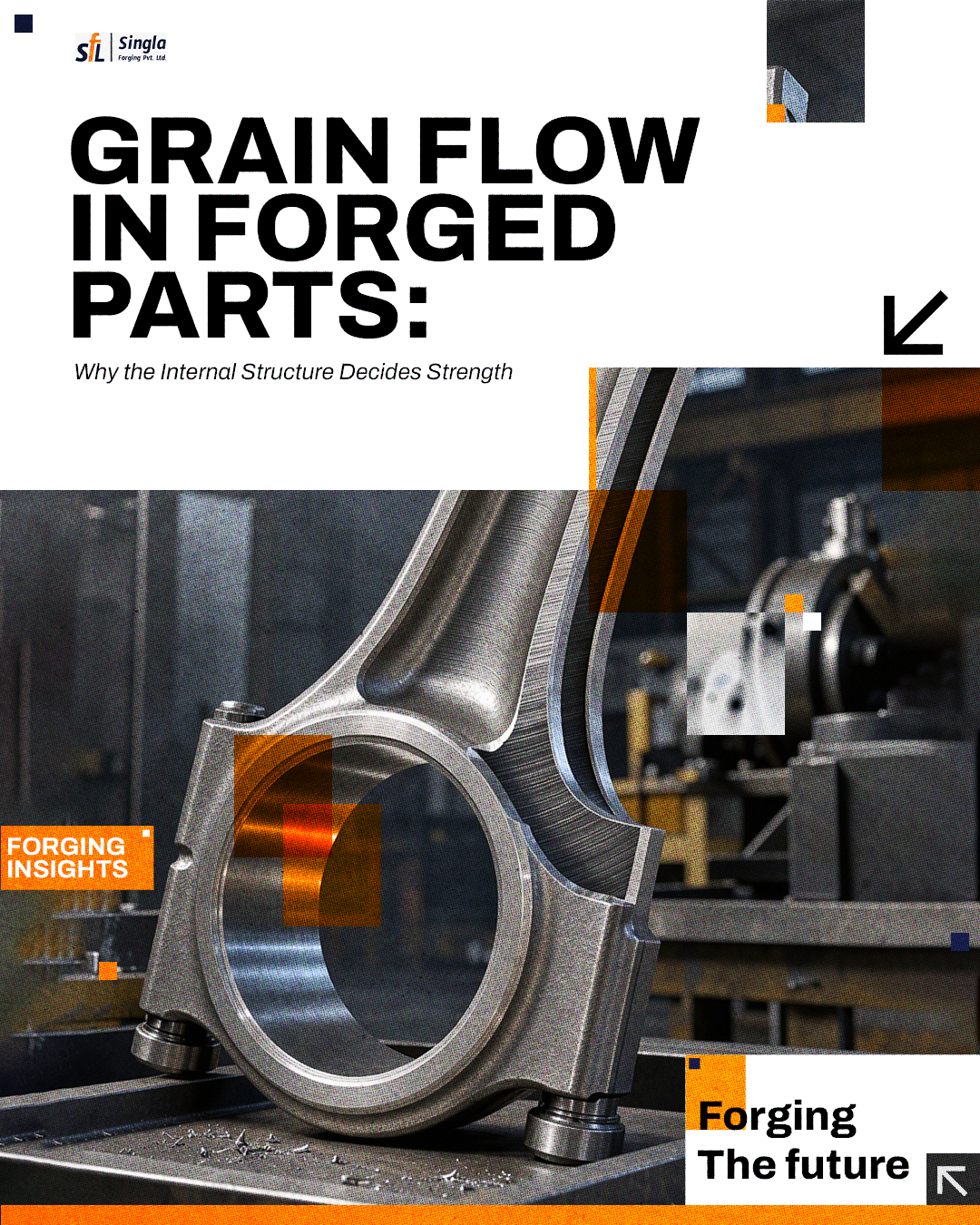
Two parts can share the same alloy, the same dimensions, and the same hardness reading, yet one survives a million load cycles while the other cracks at a fraction of that. The difference is usually invisible from the outside. It sits inside the metal, in the direction its grains point. That is grain flow, and it is one of the main reasons forging has stayed essential in demanding industries.
What Is Grain Flow?
Metal is made of microscopic crystals called grains. In a cast ingot or a fresh billet, they are fairly random in orientation and often carry tiny voids, segregation, and non-metallic inclusions between them.
When the metal is forged, heated and shaped under heavy compressive force, the grains and those inclusions are stretched and aligned in the direction the metal moves. Etch a cross-section of a forged part and you see flowing lines that follow the part’s contour, much like the grain in a piece of wood. Those lines are the grain flow.
Why Direction Matters So Much
Metal is anisotropic once it has been worked: its properties differ depending on the direction you test it.
- Along the grain flow, the elongated grains and inclusions line up with the load. Strength, ductility, and fatigue resistance are at their best.
- Across the grain flow, the weak boundaries and stringers of inclusions sit directly in the path of the stress. Cracks start more easily and travel more readily.
Think of a bundle of drinking straws. It is hard to crush end-on, but it splits easily along its length. Metal grains behave in a similar way, though less dramatically. The goal in forging is to make sure the strong direction of the metal faces the main stress direction of the part.
How Forging Builds Favorable Grain Flow
Forging does more than shape a part; it refines the structure in several ways:
- Closing internal voids. Compressive force welds shut porosity and shrinkage cavities left over from the original ingot.
- Breaking down coarse structure. Combined with heat, deformation refines large grains into finer, more uniform ones, which improves toughness.
- Aligning inclusions. Instead of leaving impurities scattered as stress concentrators, forging stretches them into thin, directional lines that are far less harmful.
- Following the geometry. In closed-die forging, the metal is forced to fill the die cavity, so the flow lines wrap around features like flanges, bosses, and fillets.
How Other Processes Compare
Casting produces a non-directional structure. Grains solidify in random orientations, and porosity or shrinkage can hide inside thick sections. For many components this is perfectly acceptable, but it offers no built-in directional strength.
Machining from bar stock is the subtler problem. A bar has grain flow running along its length. When you cut a complex shape from it, such as a gear blank or a bent lever, the cutter slices straight through those flow lines. The grain ends are exposed at the surface, which makes the part more vulnerable to fatigue cracking and stress corrosion.
Forging reshapes the grain so it follows the part. A crankshaft, for example, is forged so the flow lines curve through the crank throws rather than being cut across them.
Additive manufacturing can achieve excellent results, but its grain structure depends heavily on build direction and process parameters, and it often needs post-processing such as heat treatment or hot isostatic pressing to approach forged-level performance.
Where Grain Flow Matters Most
Anywhere failure is costly, grain flow becomes a design consideration:
- Automotive: crankshafts, connecting rods, steering knuckles, and axle components
- Aerospace: landing gear, turbine discs, and structural fittings
- Oil and gas: valve bodies, flanges, and high-pressure fittings
- Railways and heavy equipment: couplings, wheels, and drive components
- Hand tools and hardware: wrenches, hooks, and rigging, where sudden overload is common
In these applications, parts see fatigue, impact, or both. Favorable grain flow raises the resistance to each.
Design Tips to Make the Most of Grain Flow
- Align the flow with the principal stress. Discuss load paths with your forging supplier early.
- Use generous radii. Sharp corners force flow lines to fold or break; smooth transitions keep them continuous.
- Avoid unnecessary machining across the flow. Where possible, near-net-shape forging reduces the amount of metal cut away and the number of exposed grain ends.
- Watch for defects. Laps, folds, and flow-through defects occur when metal folds over itself during forging, and they can undermine the benefit.
- Specify checks where it counts. Macroetch inspection, microstructure examination, and fatigue testing can confirm that the flow pattern matches the design intent.
Common Misunderstandings
“Forging just makes the part stronger because it’s denser.” Density helps, but the real gains come from directional alignment, refined grains, and a cleaner internal structure working together.
“Same material, same strength.” Material grade sets the potential. Processing determines how much of it you actually get.
“Hardness tells the whole story.” Two parts can have identical hardness while differing greatly in toughness and fatigue life because of their internal structure.
Conclusion
Strength is not only a matter of choosing the right alloy. It is also a matter of how the metal’s internal structure is arranged. Grain flow decides whether a part’s strongest direction faces the loads it will carry, and forging is the process that lets engineers shape that structure on purpose. When reliability, fatigue life, and safety matter, looking inside the part is as important as looking at its drawing.